
The software landscape is undergoing a significant seismic shift right now. Businesses no longer have the luxury of waiting months for custom software solutions. Consequently, enterprise low-code application development has emerged as a critical strategy for staying competitive in a fast-paced digital market. This approach allows organizations to build applications with minimal hand-coding, utilizing visual interfaces instead.
Alt Text: Business team collaborating using an enterprise low-code application development dashboard on a large monitor.
Accelerating Innovation via Citizen Developer Tools
Historically, software creation was solely the domain of highly skilled programmers. However, the rise of modern platforms is democratizing this process. According to research giants like Gartner, low-code will be responsible for the majority of application development activity in the near future.
This shift empowers “citizen developers” within an organization. These are non-IT staff who can now build functional business apps. Therefore, companies can solve specific operational problems faster than ever before. To ensure these new applications look professional and function well, integrating them with expert web design and development principles remains essential.
Bridging Gaps with Rapid Software Deployment Strategies
Enterprise low-code application development is not just about speed; it is also about collaboration. Often, there is a significant disconnect between IT departments and other business units. Low-code platforms bridge this gap effectively.
For instance, a marketing team could utilize a platform like Bubble or Microsoft Power Apps to prototype a customer portal quickly. Simultaneously, they could work with a digital marketing agency to ensure the tool aligns with broader campaign goals. This collaborative approach ensures that the final product serves actual business needs rather than just technical specifications.

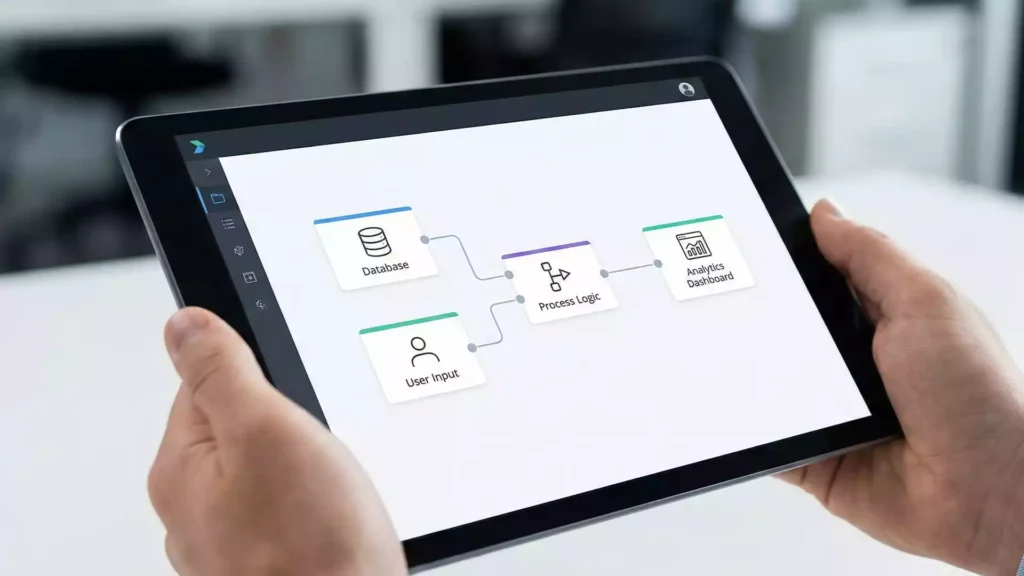
Alt Text: Close-up view of a tablet displaying a simple enterprise low-code application development interface with logic blocks.
The Future of Business Agility
The trend toward these platforms shows few signs of slowing down. Analysts at Forrester continue to highlight the immense market growth in this sector. As these tools mature, they become capable of handling increasingly complex tasks.
However, user experience remains paramount, regardless of how easily an app is built. Investing in professional creative design ensures that these internally developed tools are intuitive and engaging for end-users.
Ultimately, adopting enterprise low-code application development means embracing agility. It allows your business to pivot quickly in response to market changes reported by tech news outlets like TechCrunch. To learn more about how we approach innovative solutions, visit our about us page. If you are ready to modernize your digital strategy, please contact us today.